
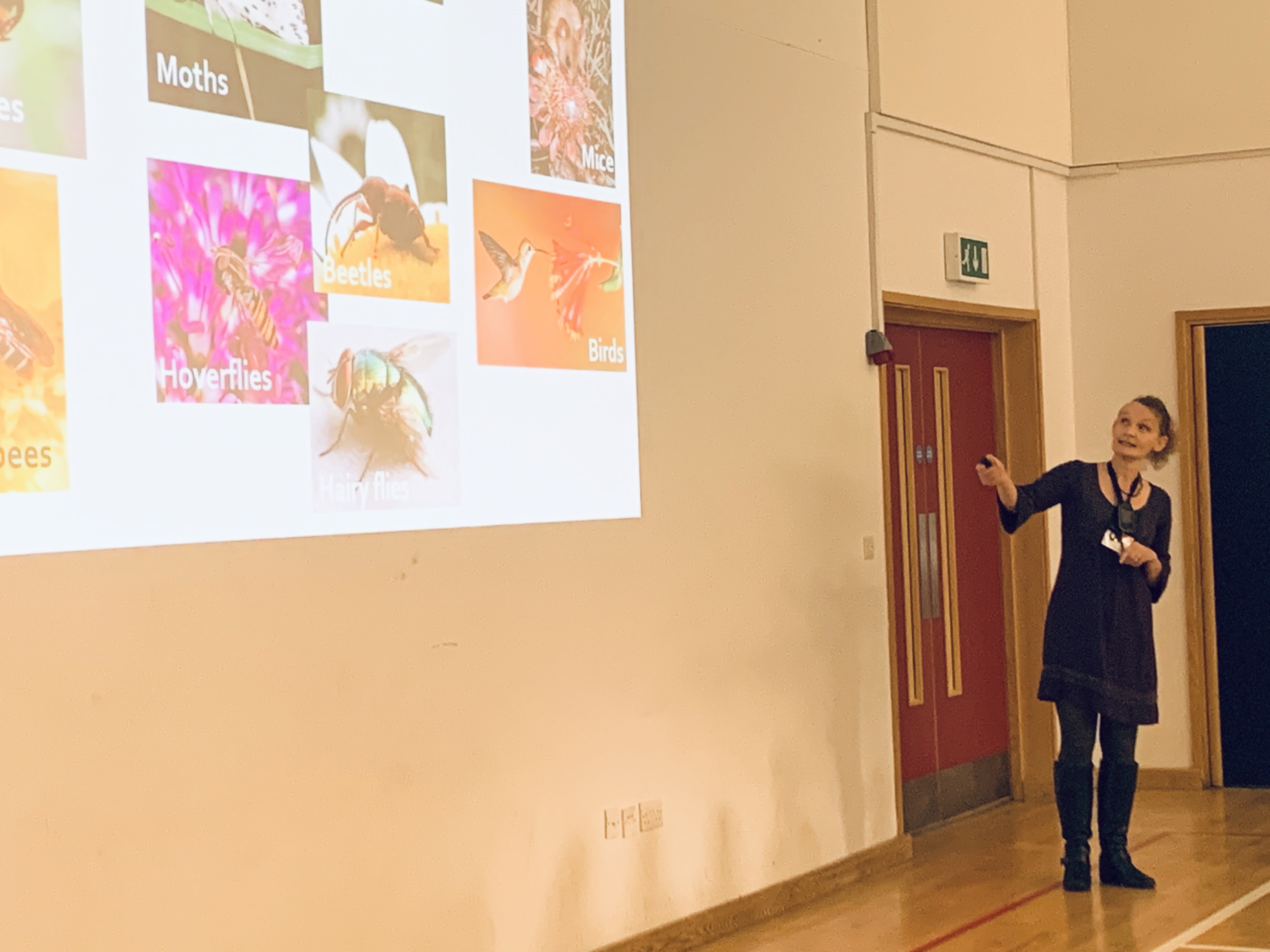
Last Monday, the whole school enjoyed a bee talk with Professor Juliet Osborne who told us many interesting bee facts. But we were all left with so many questions that she didn’t have time to answer them all.

Each class has written a question they are eager to know the answer to.
Find out what they are below. Don’t forget to check the comments for Professor Osborne’s answers.
Year 1
Oak Class How do bees make their nectar into honey?
Walnut Class Why does a bee have 4 wings?
Year 2
Birch Do bees eat anything other than pollen and nectar?
Chestnut: Why do bees have black and yellow stripes?
Year 3
3M How long do Queen bees live for?
3B What is the difference between a wasp and a bee?
3J How many bees are there in a hive?
Year 4
4A What would happen if the bees could not find anything to pollinate?
4K Who discovered bees and in which country were they discovered in?
4C Can a bee sting another bee?
Year 5
5P What is the biggest bee that you have seen?
5W Why does the queen bee never leave her hive?
Year 6
6B How long does it take for bees to build their home?
6C What does freshly made honey look like under a microscope?
6M Are bees colourblind?
Thank you for reading and answering all of our questions.

 chasebridgeprimary.school.blog
Good questens !!
LikeLike
it looked coooooool
LikeLike
She is my aunt
LikeLike
HARRAY!!!!!!!
LikeLike
How do the bees make their hives.
LikeLike
Hi everyone at Chase Bridge. Great questions and sorry not to reply sooner! I got Dr Pete Kennedy to help me with the answers – he is a beekeeper and bee researcher too. So LOTS of information below:
Year 1 – Oak class: How do bees make their nectar into honey?
Making honey from nectar involves a team effort. The first step starts with a honeybee collecting the nectar from a flower. Sometimes a bee has to really stretch to reach the nectar at the very bottom of the flower. The bee sticks her tongue out to lick the nectar and swallow as much as she can. She may have to visit over 100 flowers before her honey stomach is full, and she is ready to take the nectar back to her hive.
As soon as she drinks the nectar, the process of making honey begins. Nectar is mainly sugary water so a chemical called an ‘enzyme’ is added to the nectar which helps change the sugars in the nectar. But making honey from nectar is a slow process and still has a long way to go.
Once the honeybee gets back to her hive, she wants to unload the nectar that she is carrying quickly, so that she can go out again to collect some more. So she passes the nectar from her stomach to a ‘house bee’. This bee is too young to go out to look for food, but can help with changing the nectar into honey in the safety of her hive. She may move the nectar between her stomach and her mouth a number of times, occasionally forming a drop on the end of her tongue to help drive the water off the nectar and make it gloopy. This can be repeated 80-90 times before the nectar is placed in the honeycomb. At this point we do actually call this liquid ‘honey’, but it is still not ready as it still has too much water in it to keep for long.
The bees spread the fresh honey out and other house bees join in and fan their wings. This means that lots of air passes over the spread-out honey to remove the water (a bit like putting your wet hands under a hand-dryer). The honey becomes more and more gloopy and sticky until it contains very little water. At this point, they honey is ready to be stored for the winter and the bees put a thin layer of wax (like a lid on a jar) ready to eat when needed – and this is when it is ready for the beekeeper to collect as well.
Year 1 – Walnut class: Why does a bee have 4 wings?
Insects were actually the very first animals to fly (300 – 360 million years ago) well before any birds, bats or even dinosaurs did. For a long time, they had the empty skies to themselves. Unfortunately, wings developed in insects so long ago, it is hard to be sure exactly how this happened. But most flying insects have 4 wings, or rather 2 pairs of wings (a pair for forewings and a pair of hindwings). Dragonflies, damselflies, butterflies, and moths are just a few with 4 wings. Beetles also have 4 wings but their forewings have hardened to become a protective case under which they fold their hindwings when not in use. Other insects have lost their wings completely as they no longer need them or else they just produce adults with wings when needed, for example ants or greenfly.
So bees and wasps have stuck to the original successful design for most flying insects by keeping 4 wings.
Nearly 100 years ago, a scientist did actually suggest that bees should not be able to fly. He was thinking more about bumblebees with their big bodies and small wings, and questioned how these little wings could keep the bee in the air. But he was imagining the wings working like those of an airplane. Instead, the 4 wings of a bee do not just allow the bee to flap up and down move in a more “figure of 8” movement, creating mini-hurricanes of air currents around the 4 wings that gives them more lift and meaning they can fly very well!
Year 2 – Birch class: Do bees eat anything other than pollen and nectar?
Bees mainly eat pollen and nectar but what they eat changes through their life. A bee’s life actually starts when she is born as an egg. She hatches from the egg as a small soft white-skinned larva and is completely dependent on her grown-up sisters to feed and look after her. She is given a white liquid food (brood food) that is mix of sugar, pollen and various secretions from glands of the nurse bees looking after her. This food is so rich that she grows fantastically quickly in just 6 days from a little larva barely visible to our eye to one that completely fills her brood cell and is virtually as large as the adult bee. At this last stage, she eats no more, spins a cocoon hidden under a wax lid and, completely re-arranges her body over the next 12 days to emerge from her cell as a young adult bee. Over the first few days of her early life she eats a lot of pollen … or rather something often referred to as ‘bee bread’. This is actually pollen mixed with a little honey, yeast and friendly bacteria that help break down the pollen into a dough-like, more easily digested food. Eating bee bread helps these young bees produce the liquid food (brood food) from their glands that they feed to young larvae. As adult bees become older, they eat more nectar and honey to give them the energy they need for their active lives, especially when searching for food outside the hive.
Something you may not know: A young larva can be fed an extra special brood called “royal jelly” that makes her grow even quicker, bigger and live a lot longer … it makes her turn into a young queen bee.
But adult worker bees are attracted by other sweet things, especially when there are not as many flowers about with lots of nectar and pollen. For example, they will sometimes collect the sweet juices from over-ripe fruit. And they sometimes collect the sugar liquid produced by other insects, like greenfly. You may see bees, wasps or ants and wasps attracted this sugary liquid, known as ‘honeydew’, from the surfaces of leaves. It tends to make a very dark, strong flavoured honey. Not everybody likes honeydew honey but, in some countries, it is highly prized.
Year 2 – Chestnut class: Why do bees have black and yellow stripes?
Some animals have very distinct colour patterns that make them stand out. So rather than hide away, they are advertising their presence. When this colour pattern is meant as a warning, it is called “aposematic”. Some colours like bright reds or yellow, especially when with black, are colours that many animals instinctively know are a warning. So the warning is meant for other animals that might be thinking about eating the brightly coloured animal; perhaps a bird like a Great Tit eyeing up a bee and wondering if it tasty. The yellow and black stripes of bees warn other animals that they have painful sting with which they can defend themselves, so the bees are less likely to be eaten.
Other insects even copy this colour pattern, to help protect them from animals that might be tempted to eat them, even though they do not have a sting or taste nasty. For example, there are some hoverflies that look very much like a bee or wasp at a glance.
Year 3 – Class 3M: How long do queen bees live for?
A honeybee queen can live up to five years. This is amazing when you consider that most worker bees do not live longer than six weeks. But there are many factors that will affect how long a queen honeybee actually lives. Early in her life she may have to fight with other sister queen bees to decide who gets to lead her colony of bees. If she wins, she stays; if she loses, she may have to leave with some of the other workers or may even be killed in the fight with her sister. While she is healthy, well fed and produces 2000 eggs per day, she will maintain a strong colony with lots of bees that will be able to survive many situations. If she becomes ill or the amount of food near the hive becomes very low, the colony will weaken and may also affect how long the queen lives. On average, queen bees live for two to three years. As she gets older, she will produce fewer eggs and eventually the worker bees decide to replace her by feeding a few of her larvae, from freshly hatched eggs, an extra special food, royal jelly, that turns them into young queens.
Year 3 – Class 3B: What is the difference between a wasp and a bee?
The biggest difference between wasps and bees has to do with what they eat. Wasps eat meat while bees are vegetarian. But I need to be careful here as there are many different bees and even more different wasps even just in Britain. So we will focus on the difference between the honeybee and the common wasp.
Both are social insects and therefore live in large colonies (or families) with many many sisters and a few brothers. But only one member of the wasp family survives through the winter – the queen wasp. The queen wasp crawls under leaves or amongst twigs or under bark to sleep (or hibernate) through the whole winter until she wakes the following spring. Now on her own, she has to feed and look after herself until after she has built a small paper nest. In this, she builds horizontal comb made of paper (chewed wood pulp) into which she lays her eggs and raises her young. Once the young have grown into adult wasps, these workers will look after the queen and the next generations of young. A wasp colony may grow such that a nest may contain several thousand workers. At the end of the year, the colony raises males and new queens. The queens leave the nest to look for somewhere to spend the winter, but all worker wasps and males die before winter.
The honeybee queen is unable to look after herself on her own and therefore does not hibernate. Instead she over-winters together with the rest of her family. It is because honeybees have to survive in such big numbers through the winter that they have to collect and store so much honey during the summer. The queen may lay fewer eggs during winter but she does not hibernate. Honeybees live in hollow trees or special boxes built by beekeepers called hives, and shelter in this way from the weather. Inside their nest or hive, they build vertical combs made of wax. As soon as it is warm enough, forager bees will explore flowers in the surroundings of the nest in the hope of collecting food.
Both adult wasp and adult bees like nectar and other sweet things. They need the sugar in these to given them the energy need for their busy lives. But wasps also hunt other insects, including bees, as this gives their young the protein they need to grow. Honeybees instead choose to collect pollen as their source of protein to allow especially their young to grow.
Year 3 – Class 3J: How many bees are there in a hive?
You can get different sized hives that can contain different numbers of honeybees, but standard-sized hives can have as many as 50,000 – 60,000 bees per hive in the middle/late summer (July/August). But they are not always this big. Numbers in a hive typically go up and down according to the time of the year, so there may just be 10,000 -20,000 bees in a hive in winter.
When a colony of bees in a hive gets so big that they are getting short of space in their home, half of them may decide to look for a home elsewhere. The ones that leave are collectively called a bee swarm. To succeed, a swarm must find a sheltered empty home in an area with good food nearby. They will be leaving most of their food behind, except what they can carry in their stomachs, so they need to build up enough food reserves to allow the colony to grow and to make sure they have stores for the winter period.
Year 4 – Class 4A: What would happen if the bees could not find anything to pollinate?
If a bee could not find any flowers – then she would have no nectar or pollen to eat and she would have to keep searching. Eventually the hive of bees would get very hungry and not be able to grow. They certainly would not be able to store honey. Usually the hives have a few days of stored food so that they can get through a few days when they can’t find any flowers.
Year 4 – Class 4K: Who discovered bees and in which country were they discovered in?
I don’t know! That’s a good question….and I would love to hear an answer?!
Year 4 – Class 4C: Can a bee sting another bee?
Yes, a bee can sting another bee but usually only does so if it has to. In most cases, one bee will rather just threaten another bee rather than fight, for example, when a guard bee spots a strange bee – from another hive trying to enter the guard bee’s hive (perhaps to steal some honey). If the initial warning is not enough, the guard bee will usually grab the other bee with its teeth (mandibles) and drag it away. If the stranger puts up a fight, then the two bees may try to sting each other. Sometimes other guard bees rush in to help as well, and the stranger has to fly away or risk being stung to death.
Unlike when a bee stings a large animal or us, the sting does not get stuck when a bee stings a bee. A bee can therefore sting another bee more than once.
Year 5 – Class 5P: What is the biggest bee that you have seen?
The biggest bee I have seen is the Violet Carpenter Bee (its latin name is Xylocopa violacea). This bee can be up to 2.5 cm long and, unlike honeybees, lives a solitary life style. It is deep blue (especially when the run reflects on its body) to almost black in colour and very impressive when you see it in flight. You may very well hear it coming before you see it. As big as it is, it is not aggressive and very unlikely to sting you. Until about 12 years ago, you would not have seen a Violet Carpenter Bee in Britain but would have had to cross the channel to see in mainland Europe. But it is now thought to have been accidentally brought to Britain so you might – if you are very lucky – see it in some parts of the country.
Year 5 – Class 5W: Why does the queen bee never leave her hive?
She does not leave the hive often, but she does leave the hive on maybe two occasions in her life. When she is still a young queen, who has recently taken over leading a colony of bees from the old queen, she leaves the hive to go on a mating flight. She flies far from the hive to look for mates but comes back to the hive before the evening. She may go on such mating flights for 3 or 4 days, but then returns to stay the hive for a long time, probably for a year or two. The only other time she leaves the hive is when her colony of bees has grown so large that the hive is no longer big enough for them all. At this point, the colony gets ready to split into two, with half the bees leaving the hive and the other half remaining. The old queen leaves with half the bees to travel to a new home, but she only does so when a new queen is about to hatch and take over leading the colony in the original hive.
The rest of the time she does stay inside the hive. Leaving the hive is a risk as any bee in the open could be caught by a bird, frog or even a large wasp, or otherwise get caught out in the rain. Although a queen is not able to live without the help of worker bees for very long, a queen bee is not so easy for a colony of bees to replace. As she is the only queen in the hive, it makes sense to try to protect her by keeping her inside hive with many tens of thousands of worker bees able to protect and look after her.
Year 6 – Class 6B: How long does it take for bees to build their home?
Honeybees can build a wax honeycomb in a matter of a few days. And they can build enough for the colony over a few weeks. A bumblebee colony grows from the Spring onwards, and gets bigger and bigger through the summer. The bees build more cells so that the queen can lay more eggs – one in each cell. So, the more bees in a colony, then the more it grows until the end of summer.
Year 6 – Class 6C: What does freshly made honey look like under a microscope?
Well, the honey itself is clear – but very often it has pollen grains in it which you can see under a microscope. Pollen grains are really beautiful as they are all different shapes and sizes: round ones, triangular ones, long ones, spiky ones and ones with nobbly bits. Beekeepers and scientists can learn to identify the pollen grains based on their shape and size and characteristics – and then they can find out what plants the bees have been feeding on and so which flowers have been used to make the honey.
Year 6 – Class 6M: Are bees colour-blind?
No, definitely not. They can actually see a wider range of colours than we can. Our eyes are adapted to see red, blue and green, but honeybees’ eyes are adapted to see ultraviolet, blue, green and only a few shades of reddish orange. This means that a bee may look at a flower and see it quite differently from the way we see it, depending on how the surface of the flower reflects different parts of the light.
There was a famous bee scientist, Karl von Frisch, from Austria who showed over 100 years ago that bees could see and recognize colours. He later won a Nobel Prize for his work that showed that bees could tell one another where to find food by dancing the waggle dance.
LikeLike
Thank you very much for your detailed response! Fascinating!
LikeLike
Wishing all you bee-friendly Chase Bridgers a very Hap-bee Christmas! And a honey-filled New Year!
Prof Juliet Osborne
LikeLike
thanks aunt
LikeLike
i love honey and we named our queen bee polly
LikeLike
Thanks aunt+uncle.
LikeLike